Posts

Leveraging Microclimate Data, Proximal Canopy Sensing, and Machine Learning for Precise Soil Water Potential Prediction
Image
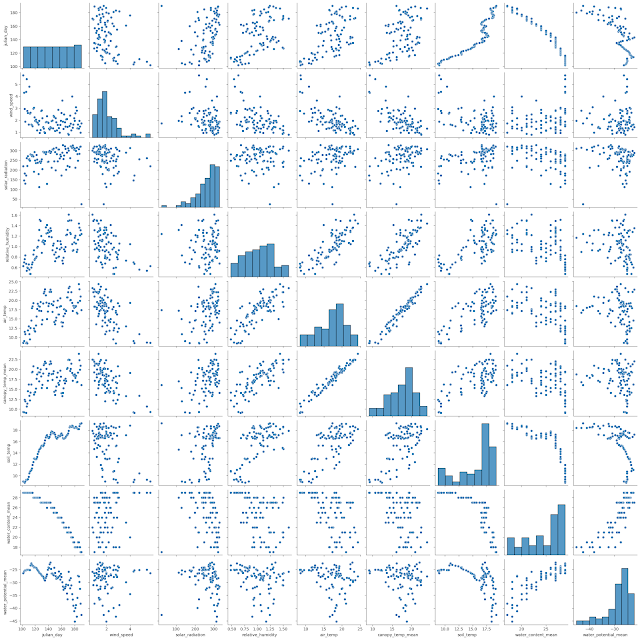
  Introduction Accurately predicting soil water potential is crucial for optimizing irrigation practices and minimizing water waste in agriculture. This project delves into the critical relationship between high resolution, in-field microclimate measurements, canopy surface temperature , time of day, and soil water content and potential. Building upon our previous work in biophysical modeling , we employ advanced machine learning techniques to investigate the impact of measurement timing on prediction accuracy. Enhanced Prediction with Machine Learning This project utilizes a range of machine learning algorithms, including: Linear Regression:  Establishes a linear relationship between features and target variables. Decision Tree Regressor:  Makes decisions based on a series of if-else questions. Random Forest Regressor:  An ensemble method combining multiple decision trees for improved accuracy and reduced overfitting. Gradient Boosting Regressor:  Iteratively b...

Powering Your Raspberry Pi Camera for Continuous Unattended Field Applications

Image
  Introduction When deploying Raspberry Pi cameras for long-term, unattended field applications, power management becomes a critical consideration. These devices can consume significant power, especially when coupled with additional modules and wireless communication. This blog post will explore the challenges of powering Raspberry Pi cameras in field conditions and present a solution for optimizing power consumption and enabling continuous operation. Power Consumption Challenges Raspberry Pi 3 models, even at low CPU speeds, draw a substantial amount of current. Connecting additional modules and establishing wireless communication can further increase power consumption. Preliminary measurements revealed that a typical field imager, based on a Raspberry Pi, could draw over 500 mA of current. This level of consumption quickly depletes a 7000-mAh acid battery, even with an efficiency of 85%. Power Management Solution To...

DIY Fruit Wetness & Temperature Sensor: Mimicking Nature for Better Crops

Image
  Remember how a few years back we discussed a leaf wetness sensor (like the  INSHU LWS ) and the potential for a similar sensor for fruits? Well, today I'm excited to share a design concept I've been working on – a  DIY fruit wetness and temperature sensor  specifically for small fruits like blueberries!  Why a Fruit Wetness Sensor? Fruit surface wetness plays a crucial role in various aspects of fruit health. Excessive wetness can lead to cracking, disease development, and ultimately, reduced yield and quality. Imagine having a sensor that mimics a small fruit, allowing you to precisely measure wetness levels and prevent these issues. The Design Concept  This sensor design utilizes a two-pronged approach (Fig. 1):  Mimicking a Fruit:  The core is a 3D-printed "filler" shaped like the top and bottom halves of a fruit. PCB Electrodes:  A two-layer printed circuit board (PCB) with strategically placed electrodes (think fruit slices) is embedde...

Plants - The Unsung Heroes of Soil Moisture Sensing!

Image
  I'm a strong advocate for plants as the best soil moisture and potential sensors . Data-driven tools like this one integrating canopy feedback provide more accurate and reliable information for crop management compared to traditional soil-based techniques. Raw data alone isn't enough. Predictive modeling that interprets this data, along with feature engineering and data cleaning techniques, is essential. Biophysical and statistical modeling approaches both have their merits, but a combined strategy offers a more complete picture.  Plant monitoring through proximal canopy sensing is surprisingly less widespread than soil-based methods. Cost isn't the barrier - proximal sensing can be just as affordable as soil sensors. Satellite and drone imagery, while valuable, lack the necessary temporal resolution. We need 24/7 monitoring, similar to soil sensors, that proximal sensing offers. Perhaps the biggest obstacle to wider adoption of plant-based methods is the lack of cohe...

Open-Source Agronomists' Python Library: CWSI and Transpiration Modeling

Image
  I'm excited to announce the availability of a Python version of the CWSI and transpiration module/class originally developed in C++ for embedded systems (see this post: 𝗕𝗶𝗼𝗽𝗵𝘆𝘀𝗶𝗰𝗮𝗹 𝗠𝗼𝗱𝗲𝗹𝘀 𝗳𝗼𝗿 𝗖𝗪𝗦𝗜 & 𝗧𝗿𝗮𝗻𝘀𝗽𝗶𝗿𝗮𝘁𝗶𝗼𝗻 𝗖𝗮𝗹𝗰𝘂𝗹𝗮𝘁𝗶𝗼𝗻𝘀 (𝗖++) ). 𝗪𝗵𝗮𝘁 𝗶𝘀 𝗖𝗪𝗦𝗜? CWSI is a reliable indicator of plant water stress, offering a valuable alternative or complement to traditional soil moisture and soil water potential sensors. 𝗨𝗻𝗱𝗲𝗿𝘀𝘁𝗮𝗻𝗱𝗶𝗻𝗴 𝗧𝗿𝗮𝗻𝘀𝗽𝗶𝗿𝗮𝘁𝗶𝗼𝗻  𝗔𝗰𝘁𝘂𝗮𝗹 𝗧𝗿𝗮𝗻𝘀𝗽𝗶𝗿𝗮𝘁𝗶𝗼𝗻 (𝗧𝗮): The amount of water a plant loses through its leaves to the surrounding air.  𝗣𝗼𝘁𝗲𝗻𝘁𝗶𝗮𝗹 𝗧𝗿𝗮𝗻𝘀𝗽𝗶𝗿𝗮𝘁𝗶𝗼𝗻 (𝗧𝗽): The maximum amount of water a plant could lose under ideal conditions. 𝗕𝗶𝗼𝗽𝗵𝘆𝘀𝗶𝗰𝗮𝗹 𝗔𝗽𝗽𝗿𝗼𝗮𝗰𝗵 By taking a biophysical approach, these models are designed to be site-independent, making them potentially applicable to a wide range of crops. However, crop-spec...

Achieve Optimal Plant Growth: How to Measure Rockwool Moisture Content with a Sensor and Smartphone

Image
Rockwool is a popular growing medium for hydroponics and greenhouse gardens. While it offers excellent aeration and drainage, maintaining optimal moisture levels is crucial for healthy plant growth. Overwatering can lead to root rot, while underwatering will stunt growth and yield. This article outlines a simple and convenient method for measuring rockwool moisture content using a sensor, handheld reader, and mobile app.  This system, comprised of the APAS T1 sensor ,  ISHTAR 1P-BLE reader , and SHUSHAN Mobile app , provides real-time data to ensure your plants receive the perfect amount of water.  As an alternative to the ISHTAR 1P-BLE, you can use the SUMERIT 2P-BLED control and monitoring node, which will allow for reading two sensors and automatic irrigation scheduling. Benefits of Using a Sensor-Based System Accuracy:  Eliminate guesswork!  Sensors provide precise moisture readings, allowing you to mak...

For CEA Growers: Tips for Substrate Monitoring and Automation

Image
  Based on my communications and meetings with our customers on solutions for substrate monitoring and decision making in controlled environment agriculture (CEA), I have identified a numbers of important areas to briefly discuss:   1) Sensor quantity optimization Most growers do not need a lot of sensors to monitor their grow rooms. There are good ways of determining the optimum number of sensors required for different applications. In addition to an unnecessarily high cost, a large number of sensors in one facility can create serious design, installation and maintenance headaches for different parties involved. More data does not translate into better insight or decision-making unless we know how to deal with “big data”. Large amount of data that grower does not know what to do with leads to frustration and mistrust in the technology.   More data does not translate into better insight or decisions unless we know how to deal with “big data”. Large amount of data that gro...